The Environment of Quantum Possibility: Lessons from the UAE
When I visited Abu Dhabi in 2024, it was both my first visit to the Emirates and my first journey outside the United States. I did not yet have the comparative view I would later develop by traveling through different…
Cierra Lunde · · 12 min read
When I visited Abu Dhabi in 2024, it was both my first visit to the Emirates and my first journey outside the United States. I did not yet have the comparative view I would later develop by traveling through different quantum ecosystems.
Even then, I was struck by the difference in the dialogue surrounding science and technology. At XPANSE, I listened to public officials speak with a level of technical fluency that moved easily between scientific capability and implementation. There was a notable focus on preparing a future workforce for the challenges created by rapidly advancing digital technologies. There was also a practical consideration of how to give students the experience they need to develop innovative solutions, as opposed to learning about innovation from a distance.
This was not the standard portrayal of technological ambition confined to a speech for the sake of speech. Science and technology appeared as cultural values, reinforced across institutions that were themselves oriented toward experimentation and the future.
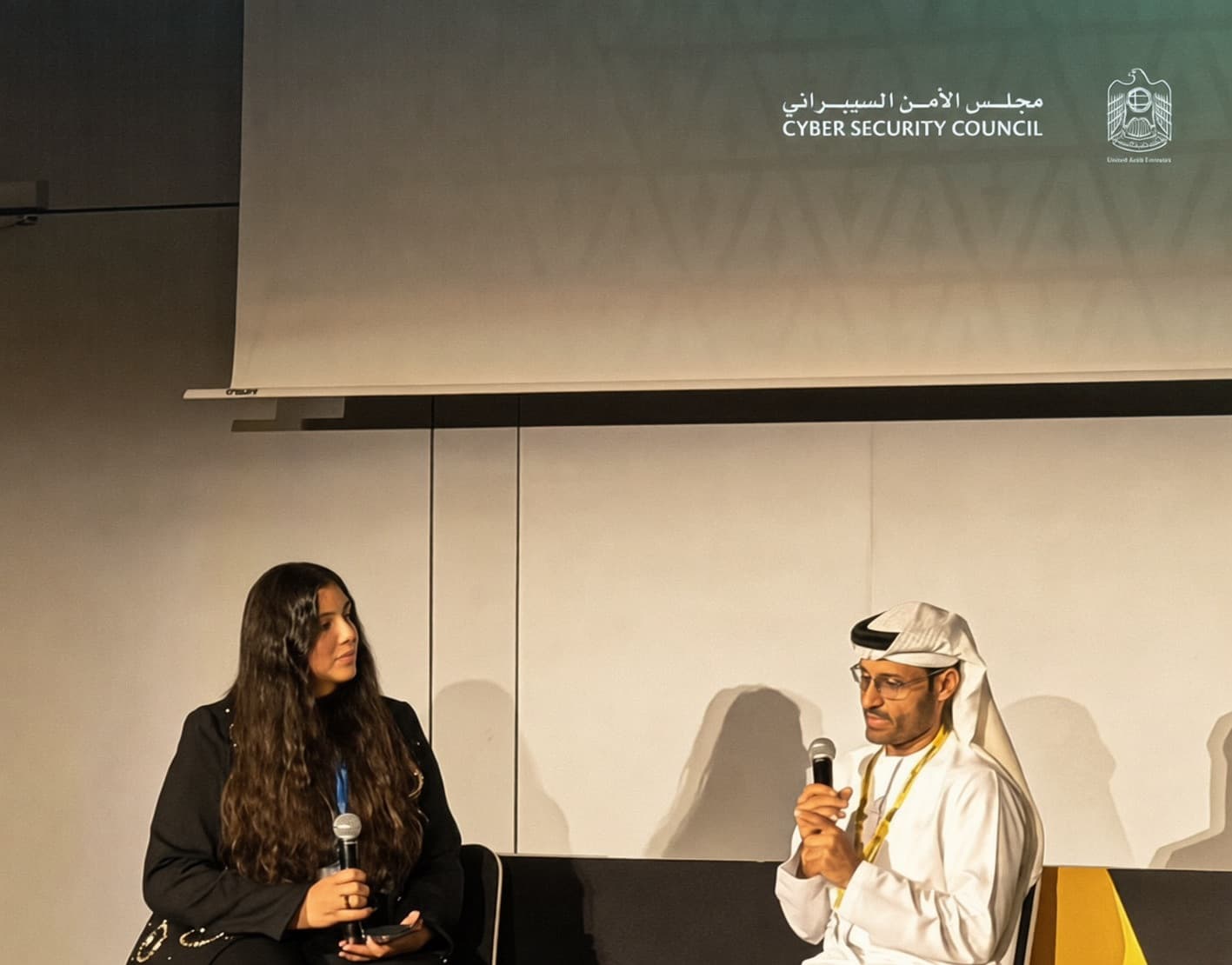
Earlier this year, through the ITU’s Quantum World Tour, I returned to the United Arab Emirates in a new way, with an updated lens on the many parts that go into building a quantum ecosystem. At the 2026 AI for Good Global Summit in Geneva, during the Quantum for Good track, I continued that conversation in a fireside chat with H.E. Dr. Mohamed Al Kuwaiti, Head of Cyber Security for the UAE Government.
Across these conversations, what can be gleaned is that the UAE rejects the treatment of quantum as a completely separate pursuit. Instead, it is prioritizing quantum within a broader model that includes cybersecurity, artificial intelligence, cloud infrastructure, education, economic development, regulation, research, commercialization, and public awareness. Quantum is part of technological life in the UAE.
This is the most compelling way to understand the country’s emerging quantum model. The UAE’s quantum story is about the environment that is being cultivated around it.
A Strategy Beyond the Technology
The UAE is finalizing a national quantum technology strategy, but the importance of that strategy lies partly in how it is situated. Rather than an island of ambition to later be absorbed by the rest of the digital economy, quantum is being considered as a single layer within a larger technological architecture.
This is essential because quantum computing is a new computing paradigm, but it is not a replacement for every previous form of computing. The likely future is hybrid, with workflows in which classical processors, GPUs, AI systems, and QPUs are pulled in according to the nature of the problem at hand.
It follows that a quantum-ready society must go beyond funding machines for a small technical class to operate. It requires us to think about education, scientific literacy, access, governance, security, and the way a society defines its relationship with technology.
In the Quantum for Good fireside chat, H.E. Dr. Al Kuwaiti described readiness through three connected concerns. The first was the exposure of devices, infrastructure and information to quantum-era cryptographic threats. The second was capacity—whether a workforce exists that can understand, develop and implement the technology. The third was economic sustainability, or whether research can move through a pipeline toward application, commercialization and return.
This is a much more demanding, and well-earned, definition of readiness than the presence of hardware. It requires that a country both possess the technology as well as the environment surrounding it that can support it, secure it, and sustain it.
Before the Breakthrough
The UAE’s approach to education provides an early indication of how the country thinks about this challenge. Beginning in the 2025–2026 academic year, artificial intelligence became an official subject across public education from kindergarten through Grade 12. The curriculum is intended to be comprehensive, spanning technical concepts as well as ethics and policy. This is relevant to quantum because it demonstrates a willingness to adapt education around the dynamism of technological progress in real time.
The inaugural Advanced Technology Research Council (ATRC) School Program further encouraged this philosophy. Developed with researchers from the Technology Innovation Institute (TII), the year-long initiative brought advanced science and technology into 84 public and private middle and high schools across Abu Dhabi. More than 5,300 students participated in theoretical learning, hands-on activities, expert workshops and student-led projects spanning fields that included quantum technologies, cryptography, secure systems, AI, energy, space, and advanced materials.
The importance of this rests in the difference between hearing that innovation is happening and entering an environment in which you can imagine yourself contributing to it.
I can, with little effort, conjure the experience of traversing the hallways of the physical sciences building at my university. As a freshman, I received a scholarship to participate in graduate-level chemistry research. I worked late nights at a local restaurant and would head straight to the laboratory after my shift, golden key in hand, my entryway to a researcher’s dream.
Formal instruction mattered. But formal instruction was not, by itself, what inspired my sense of possibility. The golden key was access to a laboratory as well as a form of permission. It meant that someone believed I was capable of entering that environment and doing something meaningful within it.
Humans are deeply experiential creatures. We are affected by what we can see, touch, and test; by the questions we are encouraged to ask; and by the tools we are or are not given access to. This is why programs that move students closer to laboratories and unfinished problems matter. They go beyond teaching students what has already been discovered and communicate that discovery is still occurring and that the student may have a place within it.
We should also be careful about assuming that quantum mechanics belongs only near the end of an educational journey. Children are capable of engaging with difficult concepts when those concepts are introduced in ways appropriate to their stage of learning. Quantum mechanics is not impossible to understand. It is different from the world as we intuitively perceive it, and that makes it challenging. Describing it as the exclusive territory of exceptional minds does not protect the science. It tells most people, before they have encountered it, that they do not belong.
Access Is Infrastructure
The UAE has been building multiple forms of access across its quantum ecosystem. In February 2026, TII launched cloud access to quantum processing units developed through its Quantum Computing Hardware Lab. The following month, TII integrated its cloud platform with NVIDIA CUDA-Q, allowing researchers and developers to submit workloads to UAE hardware through a widely used hybrid quantum-classical interface.
Other institutions are creating additional points of entry. Abu Dhabi University and Vernewell Group opened the emirate’s first academic quantum lab. The annual NYU Abu Dhabi Hackathon for Social Good brings students into intensive training and application development around quantum computing and the United Nations Sustainable Development Goals. A 2026 agreement between TII and NYU Abu Dhabi created joint research and fellowship pathways in fields that include quantum science, cryptography, advanced materials and secure systems.
Together, these efforts begin to form a continuum consisting of evertyhing from early exposure to advanced research and access to locally developed hardware. And this is relevant because access to an emerging technology is not binary. A quantum processor can be technically available while the knowledge required to use it remain out of reach.
What the UAE is beginning to construct is therefore more consequential than a collection of individual programs. Each point of entry has the potential to lead into another. A student might first encounter quantum in school, experiment with it through a laboratory or hackathon, deepen that interest through a university program and eventually conduct research using locally developed hardware. No single intervention creates meaningful access, but the surrounding environment take as a whole does.
As we consider the risk of quantum technology enlarging the digital divide, we should go beyond the usual declaration that emerging technology should be accessible. This sounds good and feels right, but we must acknowledge how difficult it is to construct the conditions through which people can meaningfully participate in it. Cloud systems cost money. Laboratories, mentors and research programs are not distributed evenly. Language can either invite curiosity or turn difficulty into a gatekeeping mechanism. A login page may make a processor technically available, but it does not eliminate the distance between someone learning within a well-supported research institution and someone trying to enter the field without that surrounding structure.
The door must exist and people must be able to see it, reach it, and imagine themselves entering. Through their efforts, the UAE is beginning to build the door and the surrounding environment that makes reaching and passing through it possible. In this way, access becomes infrastructure.
What We Can Still Learn from AI
The UAE places quantum within a model that also includes cybersecurity, AI, and public awareness. The development of quantum technology gives us a rare opportunity to be proactive. With AI, we are now living with the consequences of concentration of access and power, deployment before adequate governance, public adoption without sufficient literacy, and scant inclusion of ethics. AI is already embedded in the systems around us, which means much of the work now comes down to adding safeguards to technologies and habits that have already developed momentum.
Quantum is different in its maturity and its likely forms of adoption. We should not force the comparison too far. But we can carry the lessons forward. Governance should be considered now. Access should be considered now. Public literacy should begin now.
For the UAE, placing quantum within a broader digital strategy creates an opportunity to convert experience into foresight. The institutions already working across AI, cybersecurity, and educatiom can begin asking questions about quantum before its systems become deeply embedded. Who will have access? Who will understand the technology well enough to participate in decisions about it? Which risks must be addressed before adoption accelerates? How will technical progress be translated into public value?
The import of the UAE’s model is that quantum is not being developed separately from the institutions that will eventually need to govern, explain, secure, and apply it. By placing quantum within the wider technological environment, the UAE creates the possibility that the lessons of AI can become design principles.
Making the Abstract Real
One of the most significant examples from my conversations with the UAE was a global cyber drill, hosted by the UAE in partnership with the ITU, that involved participants from more than 130 countries. The scenarios allowed governments and institutions to experience how cybersecurity crises could unfold, including the consequences of systems that were not prepared for quantum-era threats.
The value of this approach is easy to underestimate. Cybersecurity is often invisible when it works. A successful migration does not produce a dramatic public moment; data remains confidential and infrastructure continues operating. This makes preventive work difficult to communicate, because its success is measured partly by the absence of an event.
In an immersive exercise, participants can see decisions cascade through systems in real time. They can come face-to-face with the gaps between policy and implementation, between possessing a plan and being able to act on it.
This is fundamentally the same reason that access to a laboratory matters. Humans understand differently when they can experience, test and respond. Awareness, in this sense, begins with creating an environment in which people can connect knowledge to consequence.
Security Before Advantage
In May 2026, the UAE Cyber Security Council entered an agreement with the ATRC and its entities to accelerate a coordinated national transition toward quantum-safe security. The effort brings together national cryptographic libraries developed by TII, an entanglement-based quantum key distribution system, compliance testing, workforce programs and QuantumGate’s Crypto Discovery Tool.
The Crypto Discovery Tool is especially important because organizations cannot migrate what they cannot see. Cryptography is embedded throughout sprawling digital environments. The tool is designed to discover and inventory cryptographic assets, identify vulnerabilities, support continuous monitoring and help institutions construct a structured migration path.
The urgency of this work does not require certainty about the quantum timeline. We do not yet know where the first broadly meaningful quantum computational advantage will emerge. What we do know is that sufficiently capable quantum computers could eventually break several forms of public-key cryptography that secure contemporary digital systems. We also know that cryptographic migration takes time, often years across complex institutions, and that sensitive information collected today may retain its value long enough to be decrypted later.
Post-quantum cryptography uses classical algorithms designed to resist attacks from both classical and future quantum computers. Migration is not effortless—it comes with implementation costs, compatibility questions, performance considerations, and the difficult work of discovering where cryptography is embedded across an organization.
But the protective value of beginning that work does not depend on quantum computing arriving according to a particular forecast. We can disagree about whether broad quantum advantage is five or thirty years away and still agree that long-lived sensitive data requires protection now.
This is what separates the value of foresight from the emptiness of hype. Hype parades prediction as certainty in order to accelerate attention, while foresight prepares us for outcomes whose consequences would be unacceptable.
The Complete Pipeline
The UAE model discussed by H.E. Dr. Al Kuwaiti is based on what he described as a public-private-people partnership, a confirmation that quantum cannot be developed as a singular institutional effort.
In the UAE’s post-quantum work, these roles are visible across an end-to-end pipeline. The Cyber Security Council coordinates national readiness. TII conducts research and develops cryptographic and quantum technologies. VentureOne helps move research toward commercial use. QuantumGate turns elements of that research into deployable products. Universities and education programs contribute talent and ideas.
The same principle applies to quantum computing. TII has developed in-house superconducting processors, an on-site fabrication capability, the open-source Qibo software framework and Manarat, locally developed control electronics for quantum systems. At the same time, it has built relationships providing access to international hardware and expertise through organizations including Quantinuum, IonQ, NVIDIA, Thales and AWS.
This lends itself to sovereign capability without isolation. Technological sovereignty does not necessarily mean that a country should build every component alone. In an experimental field, excessive duplication can slow progress and fragment the knowledge required to solve difficult problems. But sovereignty cannot mean permanent dependence, either.
Sovereignty is agency. It is the ability to make informed choices about what must be controlled domestically, what can be accessed through partnership, what risks accompany those dependencies, and how a country retains the knowledge required to change course.
The UAE is a relatively small country pursuing ambitious capability across AI, cybersecurity, space and quantum technology. It cannot and need not reproduce every global research program. Its advantage instead lies in the density of its institutions and the intentional effort to connect local capability with international collaboration.
When Readiness Becomes Culture
Twenty years from now, how will the success of the UAE’s quantum efforts be described? There will be familiar measurements: graduates, jobs, companies, patents, investment and the performance of quantum hardware.
But how do we fully capture whether the country has created a genuinely quantum-ready culture?
Quantum would still be found within the broader digital strategy. It would appear in education through age-appropriate points of contact that deepen as students progress. The public would encounter quantum through science museums, public programs, and accessible cloud systems. People would discuss the technology without feeling that it belonged exclusively to physicists.
A quantum-ready society is one in which people know where the technology touches their lives, participate in conversations about how it should develop, and recognize that its future is not being built somewhere beyond them.
That is the deeper significance of environment. Environment is part of innovation itself. It determines who receives the golden key, which questions are treated as worth asking, which risks are made visible, and if a society has the capacity to imagine and build.